# Jenkins 관리 업무

## Jenkins 관리 업무

{% hint style="success" %}

#### :thumbsup: WIKI 먼저 읽어 보기&#x20;

#### [Jenkins 란 무엇인가? ](/svn-and-jenkins-work/jenkins.md)

{% endhint %}

## 1. Jenkins 신규 사용자 관리

### 1.1 신규 계정 생성 요청&#x20;

> 1. 운영팀에서 신규 입사자 계정을 생성 요청
> 2. 업무 담당자가 업무 요청서 확인 후 계정 생성
> 3. 생성 완료 후 운영팀 통보&#x20;

### 1.2 Jenkins Web Site 접속&#x20;

> 1. Jenkins Web Site 접속&#x20;

#### 1.2.1 Jenkins Web Site 접속 화면&#x20;

<figure><img src="/files/rZdte8AwWUuZ2pHp2Hcl" alt=""><figcaption><p>Jenkis Web Site 접속 </p></figcaption></figure>

### 1.3 Jenkins 사용자 계정 등록&#x20;

> 1. Jenkins Login > Main > Jenkins 관리 > Security > Manage Users > 사용자 생성
> 2. Create User 에 해당 정보 기입 후 사용자 계정 생성&#x20;

#### 1.3.1 Jenkins 관리 > Security > Manage User > 사용자 화면&#x20;

<figure><img src="/files/DtS1PkoJj3cRuIsb9vD5" alt=""><figcaption><p>Main > Jenkins 관리 > Security > Manage Users > 사용자 생성 </p></figcaption></figure>

#### 1.3.2 Jenkins 관리 > Security > Manage User > 사용자 > Create User 화면&#x20;

<figure><img src="/files/VnLv6yJ6xG1lHAUr9wFa" alt=""><figcaption><p>신규 사용자 Create User 정보 등록 </p></figcaption></figure>

## 2. Jenkins 사용자 변경 관리

> 1. 운영팀에서 사용자 변경 요청&#x20;
> 2. 업무 담당자가 업무 요청서 확인 후 사용자 변경&#x20;
> 3. 변경 완료 후 운영팀 통보&#x20;

### 2.1 Jenkins 사용자 비밀번호 변경 관리&#x20;

> 1. Jenkins Main > Jenkins 관리 > Security > Manage Users > 사용자 > 설정&#x20;
> 2. Password 변경 후 Save 진행&#x20;

#### 2.1.1 Jenkins 관리 > Security > Manage User > 사용자 > 설정  화면&#x20;

<figure><img src="/files/vzIN6fgPYd8CrrlZwbXg" alt=""><figcaption><p>Jenkins Main > Jenkins 관리 > Security > Manage Users > 사용자 > 설정 </p></figcaption></figure>

#### 2.1.2 Jenkins 관리 > Security > Manage User > 사용자 > 설정  > Password 변경화면&#x20;

<figure><img src="/files/ZvhmnZsGLNzcpej4KRA5" alt=""><figcaption><p>Jenkins Main > Jenkins 관리 > Security > Manage Users > 사용자 > 설정 > Password 변경 후 Save </p></figcaption></figure>
## 3. Jenkins 사용자 계정 삭제 관리  &#x20;

> 1. 운영팀에서 계정 삭제 요청&#x20;
> 2. 업무 담당자가 업무 요청서 확인 후 계정 삭제&#x20;
> 3. 삭제 완료 후 운영팀 통보&#x20;

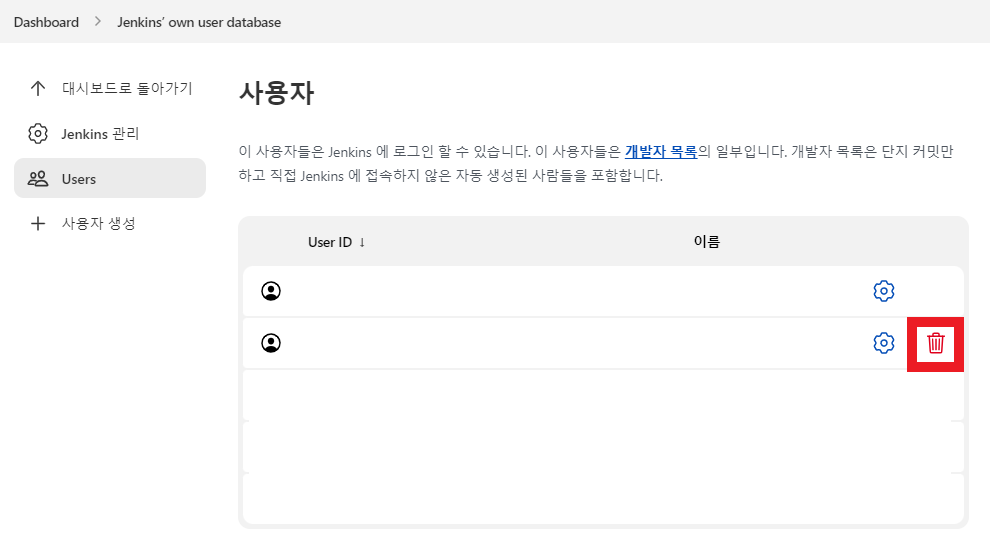
### 3.1 Jenkins 사용자 계정 삭제&#x20;

> 1. Jenkins Main > Jenkins 관리 > Security > Manage Users > 사용자 > 휴지통  &#x20;

#### 3.1.1 Jenkins 관리 > Security > Manage User > 사용자 > 삭제  화면 &#x20;

<figure><img src="/files/h72LdnFye5aJ9w9TXCBW" alt=""><figcaption><p>Jenkins 관리 > Security > Manage Users > 사용자 > 삭제 </p></figcaption></figure>

## 4. Project 신규 등록 관리

> 1. 신규 Project 등록은 운영팀 요청&#x20;
> 2. Project 명/사용자 확인 후 신규 등록 설정&#x20;
> 3. 완료 후 운영팀 통보&#x20;

### 4.1 Project 신규 등록&#x20;

> 1. Project 등록 전에 Publish over SSH 등록이 필요 함 ([4.1.1 Publish over SSH 참고](#4.1.1-publish-over-ssh))
> 2. 새로운 Item 등록 > General 정보 등록 > 소스 코드 관리 > 빌드 환경 > Build > 빌드 후 조치 > 저장 ([4.1.2 Project 신규 등록 참고](#4.1.2-project))
> 3. Main > Project Name > 지금 빌드 > 상태확인&#x20;

#### 4.1.1 Publish over SSH 등록&#x20;

> 1. Jenkins 관리 > System Configuration > 시스템 설정 > Publish over SSH 추가 > 설정 입력 후 동작 확인 > 저장&#x20;

#### 4.1.1.1 Jenkins 관리 > System Configuration > 시스템 설정 화면&#x20;

<figure><img src="/files/SasWewcqXIJzF1qONi6P" alt=""><figcaption><p>Jenkins 관리 > System Configuration > 시스템 설정 </p></figcaption></figure>

#### 4.1.1.2 Jenkins 관리 > System Configuration > 시스템 설정  > Publish over SSH 화면

<figure><img src="/files/pWvVwSMzMmb7w8KjGpHF" alt=""><figcaption><p>시스템 설정 > Publish over SSH </p></figcaption></figure>

#### 4.1.1.3 Jenkins 관리 > System Configuration > 시스템 설정  > Publish over SSH > 추가 >  Use password authentication, or use a different key(체크) > Passphrase/Password > 설정 화면

<figure><img src="/files/fMW8cPLtrLIvkX1x75rR" alt=""><figcaption><p>Publish over SSH > 추가 > 고급 > Use password authentication, or use a different key(체크) > Passphrase / Password (Server SSH 접속 할 때 필요한assword 입력) > 저장 </p></figcaption></figure>

#### 4.1.2 Project 신규 등록&#x20;

> 1. 새로운 Item 등록 > General 정보 등록 > 소스 코드 관리 > 빌드 환경 > Build > 빌드 후 조치 > 저장  &#x20;

#### 4.1.2.1 Jenkins Main > 새로운 Item  > 등록 화면&#x20;

> * Enter an item name : 프로젝트 이름&#x20;
> * Freestyle project (선택)&#x20;
> * OK (클릭)

<figure><img src="/files/Sx8qWPIhXQc4aFTRXPFr" alt=""><figcaption><p>새로운 Item 등록 화면 </p></figcaption></figure>

#### 4.1.2.2 Jenkins Main > 새로운 Item  > General 화면

> * 설명 : 프로젝트에 대한 간략한 설명

<figure><img src="/files/F1rOOPtNAH4E9H3myknu" alt=""><figcaption><p>General 화면 </p></figcaption></figure>

#### 4.1.2.3 Jenkins Main > 새로운 Item  > General  > 소스 코드 관리 화면&#x20;

> * Subversion (선택)
> * Modules
>   * Repository URL : (<http://serverip:81/svn/AAA\\_Project/trunk>)
>   * Credentials : (사용자 계정 선택)
>   * Local module directory : (. 선택)
>   * Repository depth : (infinity(선택), Ignore externals(체크), Cancel process on externals fail(체크))
> * Check-out Strategy : (Use 'svn update' as much as possibel 선택)
>   * Quiet check-out : (체크)
> * Repository browser : (자동)

<figure><img src="/files/cW411li8ANPAIm85U1Mp" alt=""><figcaption><p>소스 코드 관리 설정 화면 </p></figcaption></figure>

#### 4.1.2.3 Jenkins Main > 새로운 Item  > General  > 소스 코드 관리 >  빌드 환경 화면&#x20;

> * With Ant > JDK > jdk 1.8 설정&#x20;

<figure><img src="/files/EC0AqN0U0slUffsVCDs1" alt=""><figcaption><p>빌드 환경 설정 화면 </p></figcaption></figure>

#### 4.1.2.4 Jenkins Main > 새로운 Item  > General  > 소스 코드 관리 >  빌드 환경 > Build  화면&#x20;

> * Invoke top-level Maven targets (선택)
> * Maven Version > maven 3.6.2 (선택)
> * Goals > package -P prod (선택)

<figure><img src="/files/eDeQvbCrmJkqdVu7dN6r" alt=""><figcaption><p>Build 설정 화면 </p></figcaption></figure>

#### 4.1.2.5 Jenkins Main > 새로운 Item  > General  > 소스 코드 관리 >  빌드 환경 > Build > 빌드 후 조치 설정 화면  후 저장&#x20;

> * Send Build artifacts over SSH (선택)
> * SSH Server 설정
>   * Name (SSH Server Name (선택), [4.1.1 Publish over SSH 참고](#4.1.1-publish-over-ssh))
> * Transfer Set 설정&#x20;
>   * Source files (target/ROOT.war 설정)&#x20;
>   * Remove prefix (target 설정)&#x20;
>   * Remote directory (tomcat/webapps 설정)&#x20;
>   * Exec Command (/home/user/tomcat/bin/restart.sh 설정)&#x20;

<figure><img src="/files/ZTyioFwjhT7gocLRNtgC" alt=""><figcaption><p>빌드 후 조치 설정 화면 </p></figcaption></figure>

#### 4.1.3 Project 현황 List&#x20;

> * Jenkins Main 화면에 등록 확인&#x20;

<figure><img src="/files/yC5XGwOyzpkGi0ctFshg" alt=""><figcaption><p>Jenkins Main 화면 </p></figcaption></figure>

## \* 참고 사이트

{% embed url="<https://www.jenkins.io/doc/>" %}
Jenkins Document Site
{% endembed %}

&#x20;               [![](https://ads-partners.coupang.com/banners/768697?subId=\&traceId=V0-301-f5c692db558def48-I768697\&w=300\&h=250)](https://link.coupang.com/a/bvPl62) [![](https://ads-partners.coupang.com/banners/45962?subId=\&traceId=V0-301-879dd1202e5c73b2-I45962\&w=300\&h=250)](https://link.coupang.com/a/bvPlik)

{% embed url="<https://doc.skill.or.kr>" %}
NHN Cloud 정보 사이트
{% endembed %}

{% embed url="<https://ssv.skill.or.kr>" %}
취약점 진단 분석 평가 방법 사이트
{% endembed %}

{% embed url="<https://sul.skill.or.kr>" %}
&#x20;보안 업데이트 정보 사이트
{% endembed %}


---

# Agent Instructions: Querying This Documentation

If you need additional information that is not directly available in this page, you can query the documentation dynamically by asking a question.

Perform an HTTP GET request on the current page URL with the `ask` query parameter:

```
GET https://op.skill.or.kr/svn-and-jenkins-work/jenkins.md?ask=<question>
```

The question should be specific, self-contained, and written in natural language.
The response will contain a direct answer to the question and relevant excerpts and sources from the documentation.

Use this mechanism when the answer is not explicitly present in the current page, you need clarification or additional context, or you want to retrieve related documentation sections.
